
I have been posting articles written with AI on this blog to share topics I’m interested in and small projects I’ve worked on. I’ve been transparent about it, using a “transparency footer” following every article to indicate how it came to be — usually, which agent/model was used, the verbatim prompts and original notes, source material, session information, and other miscellaneous metadata. I want to take a moment to make a case for this, and use the most recent post as an example. The article was written with AI as a conversation partner. I’ll share some thoughts about how that worked for me personally, and what it means.
The thoughts in that piece started fragmented: a few observations about a Scholarly Kitchen post, some intuitions about high-energy physics as a model that could be replicated (a conviction I’ve held for a long time, with some experience working at CERN), and a counterargument about where tenure committees are heading (something I have discussed with friends/colleagues). In any other writing process, those fragments would have faced a series of frictions: pinning down half-formed ideas into coherent sentences, finding the right phrasing when the thoughts were bilingual, and committing anything to a page before it felt ready. Most critically, there rarely are interlocutors readily available to converse on very niche topics — when there’s no one to bounce these ideas off, no one to say “that doesn’t work” or “that could go further” immediately when these thoughts were firing in my head, fragments like these get abandoned easily. The friction of thought-to-public-expression filters out a lot of thinking that might have been worth sharing.
Having an AI agent changed that. It reduced friction at every stage: pinning down racing thoughts, translating between languages without losing nuance, and finding the shape of an argument. It also pushes back — challenging, extending, asking follow-up questions. The article that comes out of this process is almost always richer for it.
But Are These My Points?
This is the question I keep returning to, and I don’t have a settled answer. The position underlying this piece — the distrust of publishers treating business requirements as shared values, the belief that containers are losing their prestige signal, the idea that tenure committees, or in other words, the incentivization structure, are the real bottleneck — those positions are mine. I’ve held versions of them for years, long before I started this conversation.
But AI helped me articulate them, organize them, find the examples that work, and drop the ones that don’t. Does that really differ so much from talking through an argument with a colleague over coffee? Or incorporating feedback from a journal editor? Or synthesizing ideas from a dozen conversations at a conference? I don’t think it’s as much as we’d like to assume. Maybe “owning” the points — the idea that prestige comes from attaching one’s name to an idea, instead of contributing meaningfully to the landscape of ideas — is itself a hangover from an authorship model that induces toxicity.
Audience Is a Choice
Writing about scholarly publishing in English means entering a particular conversation. The same observations framed in Chinese would land differently — not just because the language is different, but because the relationship between Chinese researchers, institutes, publishers, and the global scholarly ecosystem is its own unique tangle. This applies to any other language and cultural groups. Even within the same language, stepping out of the computational STEM bubble and into, say, a digital humanities audience shifts what needs explaining and what can be assumed.
Choosing an audience is choosing what to communicate. Just because I think in English and Chinese back and forth on one topic doesn’t mean I can effectively have the same conversation with the English and Chinese speaking communities. Cross-language, cross-community writing adds dimensions but also risks leaving gaps where references mismatch. The piece you just read assumes a reader familiar with the politics and components of the open science movement, at the same time fully embracing an AI-integrated scientific landscape, when in reality, you might not find that very common in either group.
The ADHD Angle
None of these words would have been written without AI - I’m simply too ADHD to do it. Not just the article — the thinking behind it, the meta-thinking you’re reading right now. With a restless mind like mine, the gap between having a thought and getting it to a shareable form is often insurmountable without external scaffolding. The beer that loosens the nerves at a pub, the patient friend who tolerates rambling, the deadline that forces commitment — those are workarounds. AI is another workaround, and a more readily available one.
On the one hand that is exciting; it means more thinking gets out into the world. More fragments get assembled, challenged, and shared. But it obviously can also make people like me insufferable — do we really need more brain dumps out there festering in the world like dumpsters under the hot summer sun? Under usual circumstances, I’d say no, but I do also hope this will give more voice to those who didn’t have the chance to make their voices heard, due to any sort of barrier - language, neurodivergency, or not having a supportive community. The world should watch out for more thinking, not less, happening with AI. What that does to the “prestige” infrastructure — not just of papers, but of thought itself — is the conversation we need to stay in.
Some Even Meta-er Points, If That’s Allowed
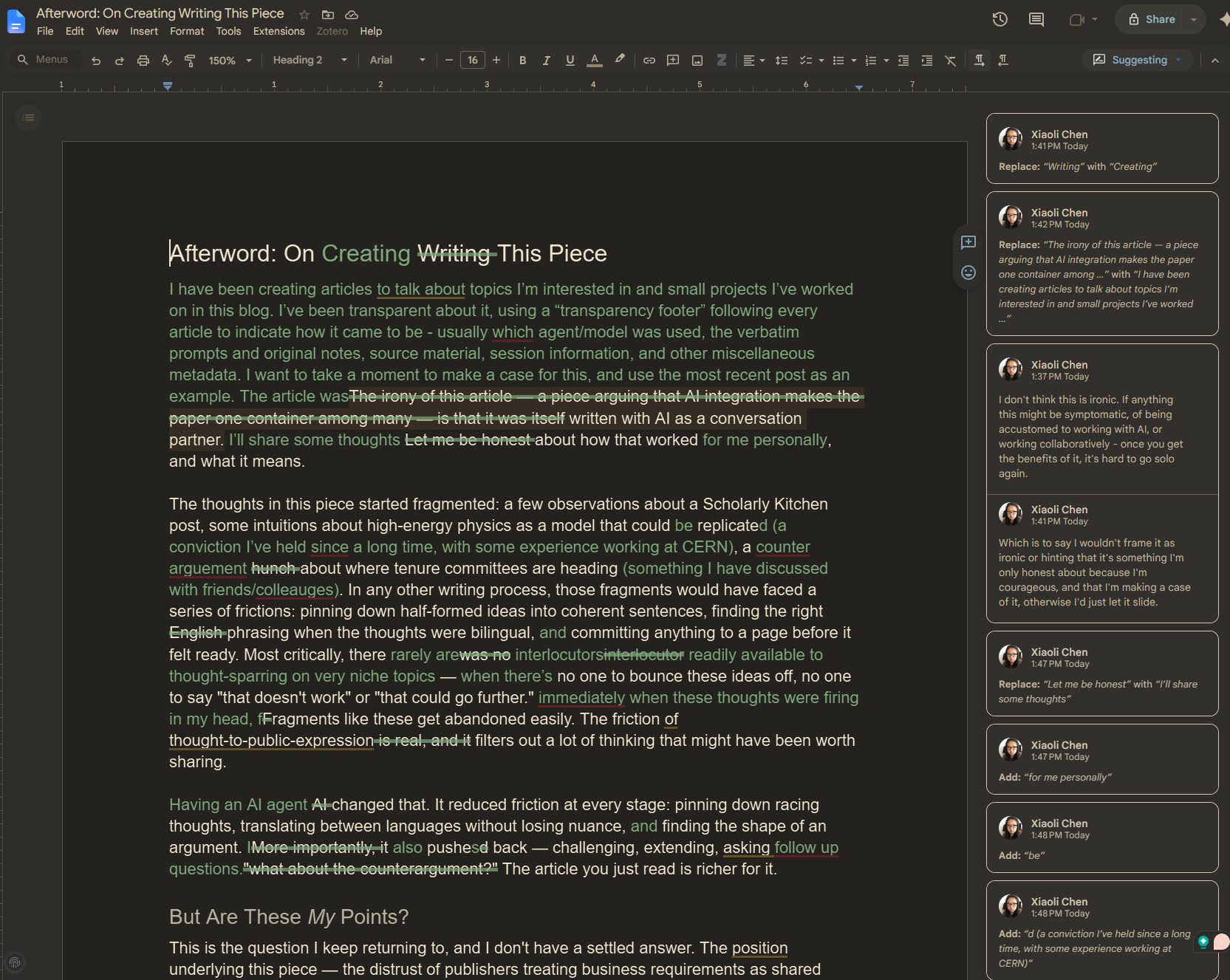
This was originally also a note rewritten by my bot based on a much shorter note I gave it. But upon reviewing what it spit out I found a lot of misrepresented points so I worked with it to edit the whole piece, and with that, it can learn more about how I write, and distil that into a skill. I know a lot of people would be horrified with this idea, but I do think this kneejerk reaction, echoing the authorship point made above, really comes from an unhealthy relationship with the concept of ownership instilled by an ultra capitalistic society but we don’t have to go there. (Reiterating my point: AI is a major mean of production and a true leftist would no doubt seize it. On all levels. Ok that’s it.)